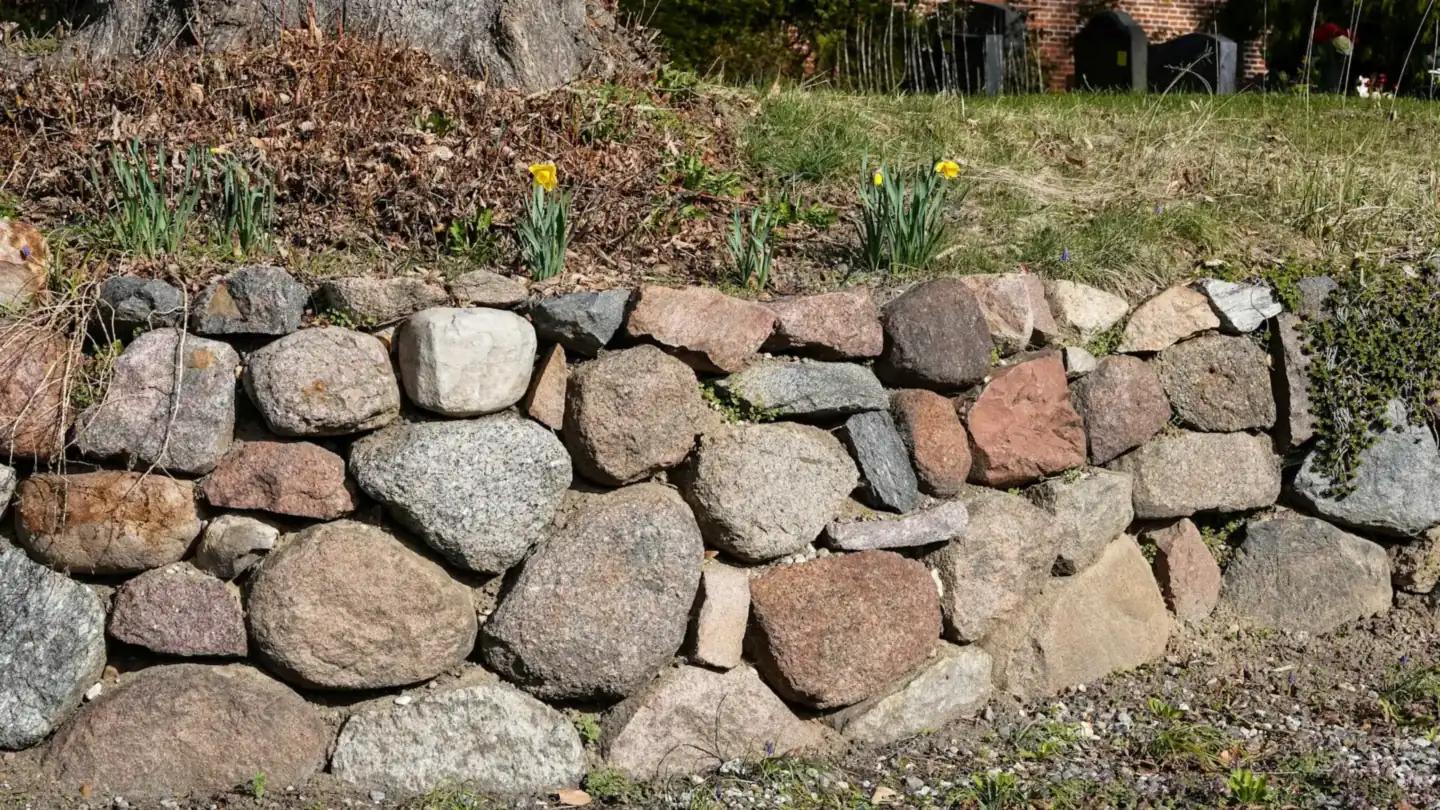
A stone retaining wall holds back soil with natural stone, either as large boulders stacked and leaned back into a slope, as a dry-stack wall of fitted stones, or as stone veneer applied over a reinforced block or concrete wall. In Corona, boulder and stone walls work best for low to moderate grade changes on hillside landscapes, where they blend with the native look of the foothills. Taller stone walls, or any wall over 2 feet from the top of its footing, still need a City permit and often a structural core behind the stone.
Three ways to build with stone
Boulder walls
Boulder walls use large stones, often weighing hundreds of pounds to a ton or more each, set with an excavator. Each boulder is bedded on a compacted base, tilted back into the slope, and placed so it bears on the stones below. Gaps are filled with smaller rock and drain rock behind the wall lets water out. Boulder walls look natural on slopes and suit drought-tolerant planting between the stones.
Dry-stack stone walls
A dry-stack wall is built from smaller fitted stones with no mortar. It stands up because of the weight of the stone, the batter (lean) of the face and careful fitting. Dry-stack walls are best kept low, for garden beds and terraces, where their texture shows well.
Stone veneer over a structural wall
For taller walls, the structure is a reinforced block or concrete wall, and natural or manufactured stone is applied to the face. You get the look of stone with the strength and permit path of an engineered or standard-detail wall.
Where stone walls fit on Corona lots
Corona sits against the Santa Ana Mountains, with the Cleveland National Forest rising behind the southern and western neighborhoods. Lots along the foothills often already have native rock, and owners want walls that look like they belong. Boulder walls are a natural choice for:
- Rear slopes where you want to gain a few feet of flat yard without a hard vertical face.
- Low terraces for planting, often combined with garden retaining walls closer to the house.
- Driveway edges and banks where a softer edge looks better than block.
- Fire-zone landscapes, because stone is noncombustible.
We often see owners near Corona Heritage Park and the Foothill Parkway hillsides choose boulders for the lower part of a slope and planting above, which reads as a natural hillside rather than a built wall.
Drainage still matters
A common myth is that stone walls drain themselves. Water does pass through gaps, but soil also washes into those gaps, and clay soils hold water against the back of the stones. Over a few rainy seasons that can push stones out of line or wash out the base. Every stone wall we build has drain rock behind it, a filter layer where needed to keep fines from migrating, and a clear outlet at the bottom. On steep or wet slopes we may add a perforated pipe as well.
Height and permits
Corona requires a permit for retaining walls over 2 feet measured from the top of the footing, and for walls of any height that hold back a surcharge such as a slope or driveway. Boulder walls are measured and reviewed like other retaining walls. Taller boulder walls, and stone walls on steep slopes, may need an engineered design. When the grade change is large, we often recommend a structural wall with stone veneer, or a set of shorter boulder tiers, rather than one tall stack. Our page on slope stabilization explains how walls, drainage and planting work together on bigger slopes.
How we build a boulder wall
- Stone selection. We choose boulders sized to the wall height, with flat bearing faces, in colors that suit your yard.
- Excavation and base. The first row is set into a trench on compacted base so it cannot slide.
- Setting. Each boulder is placed with an excavator, tilted back into the slope, and fitted so it bears on at least two stones below.
- Drain rock and backfill. Drain rock goes directly behind the stones; soil behind that is compacted in lifts.
- Chinking and planting pockets. Smaller stones fill gaps, and planting pockets are left where you want greenery.
Choosing stone versus other materials
Stone gives you a natural look and long life, but it uses more space front to back than a vertical block wall, and very tall boulder walls are harder to engineer. If you are deciding between materials, our guide to block vs concrete vs stone retaining walls compares height limits, cost drivers, appearance and permits.
Stone walls in nearby cities
Granitic boulders are part of the landscape east of Corona. On retaining walls in Riverside, hillside neighborhoods sit on slopes scattered with boulders, so boulder walls are a common choice. On retaining walls in Jurupa Valley, sloped semi-rural acreage often calls for boulder walls to flatten pads. Each city has its own building rules, which we check before we design a wall there.
Pricing factors
Stone wall pricing depends on height and length, boulder size and source, equipment access, the amount of excavation and haul-off, drainage, and whether a structural core and veneer are needed. We give a written estimate after we walk the site.
Frequently asked questions
Are boulder walls good for slopes?
Large boulders stacked and battered back into the slope work well for low to moderate walls and blend with Corona’s hillside landscaping. They need a compacted base, drain rock behind them and stones sized to the height. For larger grade changes, several boulder tiers or a structural wall with stone veneer are usually the safer choice.
What is the difference between dry-stack stone and a stone-veneer wall?
A dry-stack wall is held up by the stones themselves, while a veneer wall is a reinforced block or concrete wall with stone applied to the face. Dry-stack suits low garden walls. Veneer gives a stone look on taller walls that need steel, a footing and a permit.
Do stone walls need drainage too?
Yes. Stone and boulder walls still need drain rock and a way for water to get out, or water pressure and erosion will move the stones over time. Soil also washes into gaps between stones, so a filter layer and a clear outlet at the base help keep the wall in line for years.